The end of my previous posted “Chapter 3” has been modified and extended.
Wallace Breen’s aunt Rhonda swung open the front door and stood in the doorway. She was a tall biker in a black leather jacket and blue jeans, fit and slender at sixty years old. She removed her helmet with one hand, and with her other hand, pulled a hairpin from the back of her head and waved her silvery hair around once. Evie stood up at the far end of the bar and pointed one finger into the air. Rhonda saw it and walked toward us, high-fiving three bartenders on the way as one of them handed her a bottle of beer. I stood up as she approached.
“Keep your seat,” she said, and slid into the booth beside me.
“Hello, Evie,” she beamed with a winning smile.
“Hello, ma’am,” said Evie.
“Ma’am? Just call me Rhonda. Some of Wally’s friends call me Aunt Wanda.”
“Oaky, then. Well, this is Heavy Turner I told you about, and this is Whit.”
“I know Heavy’s dad,” said Aunt Rhonda.
“You know my dad?”
“Well, he may not remember me. Is he still a union rep for the mechanics at the racetrack?”
“Among other things,” said Heavy.
“Wally, or Wallace as you call him, respects the union because they helped his family when his dad got laid off. That’s why he is willing to meet with your little group.”
“Where’s Wally?” asked Heavy.
“All in good time.” She held her cigarette between her thumb on one side, and three fingers along the other side, pinky out. “It’ll be worth it,” and she put the cigarette to her lips. The fire burned brightly.
Up close, Rhonda conducted herself like someone familiar with social events and mannered conversation. It was an abrupt change from her catwalk by the bar.
“Whit,” she said, “I understand you publish a newspaper dedicated to the paranormal.”
“Yes. The Astral Beat. We’re working on increasing circulation.’
“And how is that going?”
“Not well. I’m not sure whether to advertise or what.”
“I would like to discuss that with you. You know, my nephew Wally saw something that still cannot be explained. I think there is a story in it.”
“Well, look,” said Heavy. “Evie wants to get some fresh air, and you two have a lot to talk about, so we’re going out back with the band.”
“We’ll be back,” said Evie. She and Heavy went around the corner to join the band outside for a smoke.
Rhonda said, “Say, Whit, I don’t suppose you’re interested in some bennies?”
“I’m not sure.”
“You ever done bennies before?” she asked.
“No.”
She laughed and said, “Here’s one. No charge.”
I thought one pill couldn’t possibly kill me, or else they would find dead people outside of the Propeller every Sunday morning. I swallowed the pill with a gulp of beer from my Coke cup.
“Thanks.”
“Don’t mention it. As I was saying, my nephew’s story is legendary, but only locally. If we do it right, we may finally identify the axe murderer and his accomplice.”
“So you do think somebody was murdered,” I said.
“Why? Don’t you?”
“I… I believe in things that can’t be explained by science. So, yeah, I’m coming with an open mind.”
“Science can certainly explain a chopped-off head,” she said, and returned her cigarette to her mouth, under-handed, and the fire glowed like a little sunburst.
I was taken aback. Was she criticizing my approach?
“I mean the running,” I said. “The body running.”
“Yes, he saw that too,” said Rhonda. “But how can he prove it? Makes a great story either way.”
I noticed that the nightclub had become darker, and very crowded, but my vision seemed more focused and scattered small lights connected the plasma trails of half-hidden nightlife, the dartboard, some ruckus from one of the bathrooms quickly shut down by bouncers. The pinball judder.
“Right,” I said, “Wow, this whole scene feels like synchronicity!”
“Don’t you mean déjà vu?” asked Rhonda
“No. Well, that too, maybe. But I mean synchronicity.”
“Explain?”
“In other words,” I said, “it is a meaningful coincidence. I knew Evie was a librarian, because I go to the library a lot. But I didn’t know her and rarely spoke to her. I didn’t know anything about the old Gregg house. Heavy never went to the library. But then Heavy met Evie because he came to the library with me on a whim, and he arranged to see her again, and he learned from her about the house, and you, and Wally. Wallace.”
“How intriguing,” said Rhonda.
She looked at me strangely and lit a cigarette with a Zippo lighter. Stretching around me for an ash tray near the wall, she smelled like patchouli and lighter fluid. She brushed across my chest more than I expected. Then she straightened up, gulped down the rest of her beer, and set the empty bottle on the table.
“Here’s the thing,” she said. “Wally doesn’t like to talk about what he saw that night. For one thing, it’s a terrible memory. For another thing, he’s been ridiculed in the past, so he hasn’t spoken about it for years. But he wants to tell the story. He feels more comfortable with me as a kind of agent.”
I couldn’t believe this was happening. This was good news. Did she know my paper was printed at home, on a used mimeograph machine, by a teenage high school nerd? I guzzled down the rest of my beer.
“I’m honored that you and Wallace trust me with your story,” I told her.
“I read your piece on the woman whose mother’s ghost came to her door, late at night, but the mother had died at the same time in another city!”
“Mrs. Mullins,” I said. “She had a ring of truth about her.”
I really wanted another beer. I wondered if I should ask Aunt Rhonda to get me a beer, I mean, if I gave her the money. Otherwise, I would need to find Heavy or maybe Lee the drummer. Suddenly the din of talking was overpowered by a quick clean drum roll and the band launched into Grand Funk’s Are You Ready.
Those three ascending chords: E F# G! E F# G! and LOUD.
It sounded great.
I snapped out of my musical reverie at the sight of Evie and Heavy bounding in through the front door and hustling toward us through the darkened path between people at the bar and people in booths. They slid back into our booth, across from Rhonda and me, and squeezed up against each other, cuddling.
“We’re freezing to death!” said Evie.
“It’s not cold outside,” I said.
“Been to the arctic?” asked Evie. “See any snowshoe hares?”
Evie had two empty Coke cups in her handbag, slid together, one inside the other. She separated the cups and passed one to Heavy, who held it under the table while pouring beer. He handed me the cup, with a big head of suds looking conspicuous as hell. I pressed the foam against my eyes and nose, guzzling the cold hops & barley nectar.
Wiping my face, I handed my empty cup to Heavy.
“Slow down, boy,” he said, handing a cup of beer to Rhonda. “Evie, you ready for another one? Hey, ya’ll, they have the best home-made fries here.”
I wasn’t hungry at all.
“Why was the evidence van at the scene?” I asked.
Evie and Heavy looked surprised. Heavy shook his head “no” but it was too late.
Rhonda was silent for a few seconds, all the while looking polite and reserved.
“I’m ready for a boilermaker,” she said, and reached into a pouch on her belt, producing a miniature bottle of whiskey. She unscrewed the cap and dropped the open bottle into a full cup of beer. Taking a sip, she smiled and said, “Would you like to meet Wally tonight?”
“Sure,” I said.
“He lives in the house in the woods. The one where the murder happened. Heavy, you driving?”
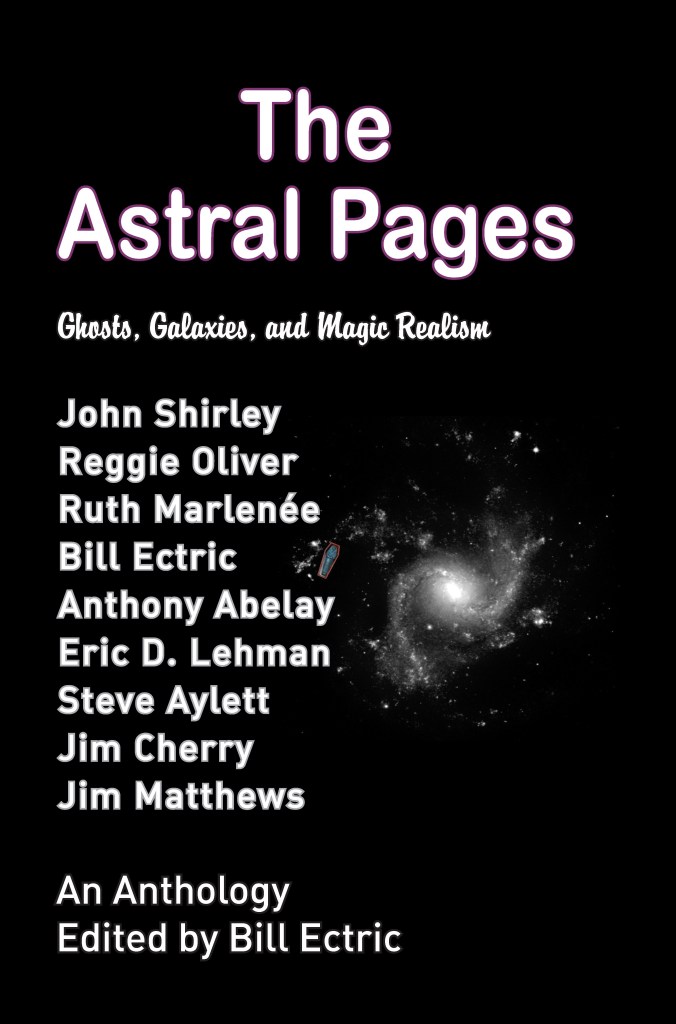
 The Astral Pages